Sarcopenia is a syndrome characterized by progressive and generalized loss of skeletal muscle mass and strength.
Dynapenia is the age-associated loss of muscle strength that is not caused by neurologic or muscular diseases.
Sarcopenia and dynapenia predisposes older adults to an increased risk of adverse outcomes such as physical disability, poor quality of life and death.
My greatest fear of growing old is losing mobility and the ability to do the things I enjoy. If I’m going to help myself age gracefully, resistance exercises – as much as I loathe them – must be a staple in my exercise regime. The following are just some notes for personal reference that I have taken from a study. The full article may be read here.
Exercises
The following are the exercises listed in the study. To make the program workable at home with minimal equipment, I have added alternate exercises that should target the same muscle groups.
Chest
Back
- Pull downs or seated cable row
- Chest supported row
- Pull-ups
- Shrugs
Arms
Shoulders
Upper Legs
- Leg press – requires a machine. Here are some alternatives.
- Leg extensions; leg curls – requires a machine. Here are some alternatives for leg extensions. Alternatives for leg curls.
- Lunges
- Machine squat – requires a machine. Here are some alternatives.
Lower Legs
- Standing calf raises
- Seated calf raises
Workout Programs
There are three workout levels outlined in the study which I have included below followed by the modifications to make them workable with minimal equipment.
Beginner
Phase 1. 2 times a week for 1 to 2 weeks. Rest between sets 2 minutes or as needed. Complete one set of 12 to 15 reps:
- Chest press
- Seated cable row; or
- Seated resistance band rows.
- Dumbbell bent over row.
- Single arm dumbbell row.
- Trx row.
- Inverted bar row.
- Seated cable pull down; or
- Dumbbell pullover.
- Banded pull-down.
- Banded straight arm pull-down.
- Pull-ups.
- Eccentric pull-ups.
- Bicep curl
- Tricep extension
- Overhead press
- Leg extension; or
- Standing leg extension.
- Squats.
- Reverse lunge.
- Bulgarian split squats.
- Step ups.
- Cyclist squats.
- Side lunges.
- Leg curl; or
- Resistance band leg curl.
- Donkey kick.
- Glute ham raise.
- Kettlebell swing.
- Stiff leg deadlift.
- Single leg deadlift.
- Glute bridge.
- Calf raise
Phase 2. 2 times a week for 3 to 8 weeks. Rest between sets 90 seconds. Complete one set of 12 to 18 reps:
- Everything in phase one; plus
- Wall push-ups.
Intermediate
Phase 1. 2 times a week for 9 to 16 weeks. Rest between sets 90 seconds. Complete two sets of 12 to 18 reps:
- Everything in Beginner Phase 2; and
- Chest flys
- Lateral raises
- Leg press; or
Phase 2. 3 times a week for 17 to 24 weeks. Rest between sets 90 seconds. Complete two sets of 10 to 15 reps:
- Chest press.
- Chest flys.
- Push-ups on knees.
- Chest-supported rows (alternatives: bent over barbell row, lat pulldown, pull-ups, or cable upright row).
- Pull-ups (assisted).
- Bicep curls.
- Triceps extension.
- Triceps kickbacks.
- Overhead press.
- Lateral raises.
- Upright rows.
- Leg press (see above).
- Leg extensions (see above).
- Lunges.
- Leg curl (see above).
- Calf raises.
Advance – Phase 1
3 times a week for 25 to 32 weeks. Complete two sets of 8 to 12 reps:
- Intermediate Phase 2; and
- Incline chest press
- Shoulder shrugs
- Hammer curls
- Rear deltoid flys
Advance – Phase 2
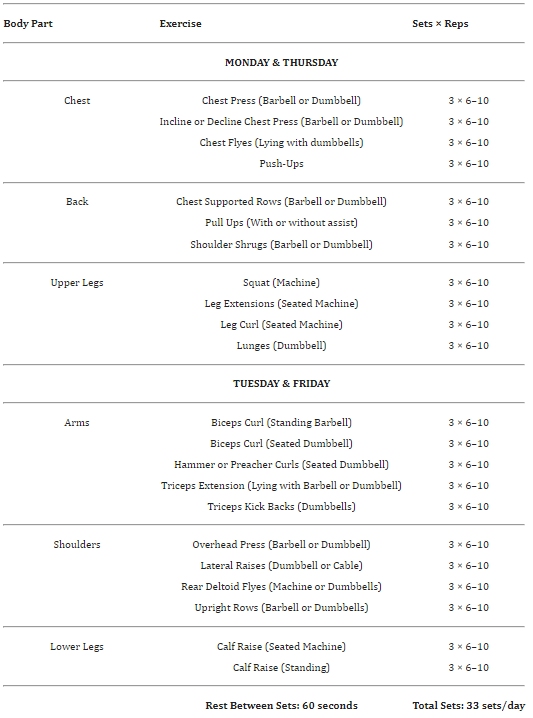
Core Work
The only gripe I have with the workouts above is that they are missing the core component.
- Sit-ups
- Plank
- Mountain climbers
- Leg raises
- Reverse curls
- Boat pose
- Rocking plank
- Scissor kick
- Bicycle crunch
- Flutter kick
- Side plank
- Side plank dips
- Side plank reach under
- Bird dog
- Sit-ups to twist
- Russian twist
- Spidermans
- Mountain climber with trunk rotation
- Woodchopper
- Side bends with weights
Discover more from Aletheiaphysis
Subscribe to get the latest posts sent to your email.